
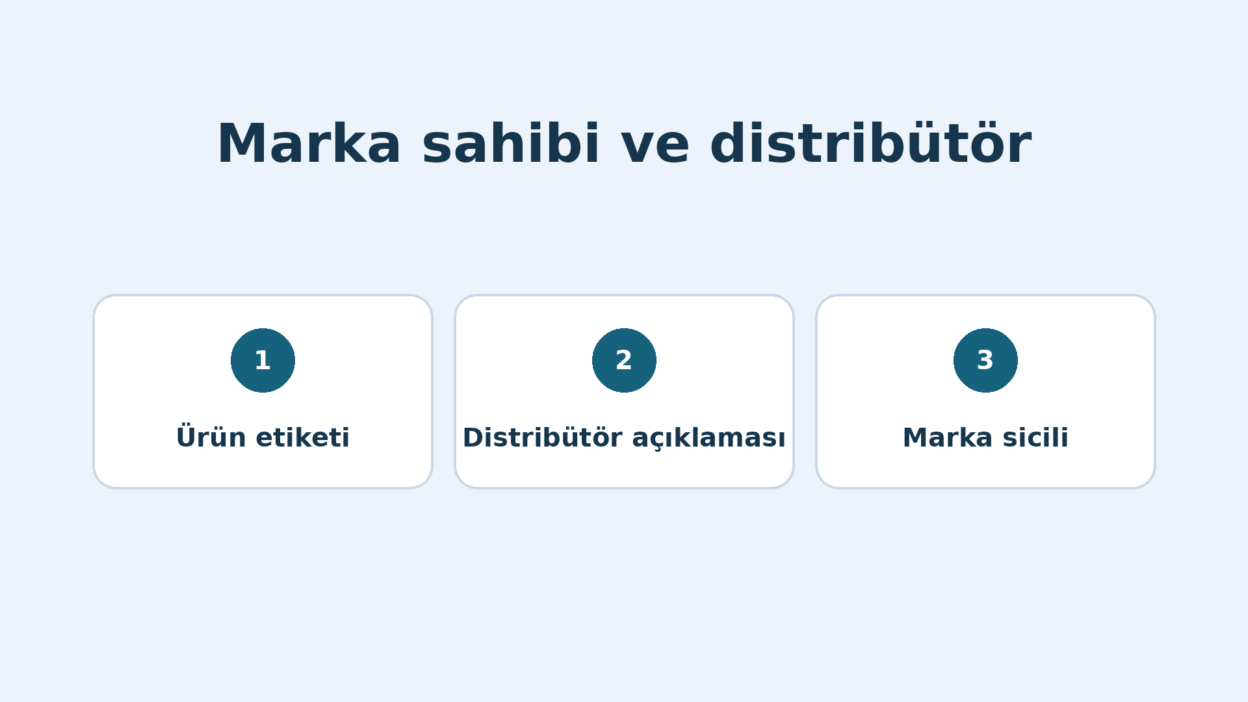
A product can display several company names, each describing a different role. The brand owner holds rights connected with the name or logo. A distributor handles distribution in a particular market. An importer brings a product into a country, while a seller is the business involved in a particular purchase.
These companies may be related, and one company may perform more than one role. The reliable way to identify them is to read the description attached to each name and check a record that answers the question you actually have.
| What do you want to know? | Where should you look first? |
|---|---|
| Who holds a trademark registration? | The relevant national or regional trademark register |
| Which company distributes the brand in Türkiye? | The brand’s Turkish website and current distributor announcements |
| Who imported this particular product? | Its label and accompanying documents |
| Which business sold you the item? | Your invoice or sales receipt |
| Which corporate group is behind the brand? | The group’s brand portfolio and company reports |
Start with the product and its label
Write down the exact brand name and model from the front of the product or package. Then check the back, underside and accompanying documents for company names identified as the manufacturer, importer or distributor.
Record the role printed next to each company name. For example, if the label identifies a business as the importer, that is what the label establishes. It does not automatically establish that the business owns the trademark.
Products sold under the same brand can also pass through different supply arrangements. An importer named on one headphone box might not be the importer named on another item from that brand. Check the specific product before applying a company name to an entire range.
Türkiye’s Ministry of Trade explains that product safety rules assign different roles and responsibilities to manufacturers, importers and distributors. The label’s role description is therefore as useful as the company name itself.
How can you verify a distributor in Türkiye?
Visit the brand’s official Turkish website. Check its contact information, authorized sales points, warranty documents and service information. Compare the company named there with the name on the product you are examining.
Next, check the date and scope of any distributor announcement. An agreement may cover a particular country, product category or period. A news release from several years ago might describe a different arrangement from the one shown in current product documentation.
Lexus illustrates the distinction. Lexus is a luxury vehicle brand developed by Toyota Motor Corporation. Its Turkish marketing notice names Toyota Türkiye Pazarlama ve Satış A.Ş. in connection with local activities. Toyota’s original Lexus production announcement establishes the brand’s connection to Toyota Motor Corporation. The documents answer different questions about the same brand.
A local company’s involvement in sales, service or marketing does not, by itself, show that ownership of the global brand was transferred to it.
What should you check in a trademark register?
For a Turkish trademark search, begin with the Turkish Patent and Trademark Office’s search service. Search the full name, then try relevant spelling variations. Examine the record holder, status and goods or services classes, along with the jurisdiction covered by the record.
A matching word alone is not enough. The same or a similar name can appear in records for different types of goods or services. A registration concerning a restaurant, for example, may have little relevance to a question about an electronic device.
For a broader search, WIPO’s Global Brand Database can help identify records from participating trademark collections. WIPO also advises checking national and regional registers directly. A record may name a subsidiary; if you need the parent group, verify the corporate relationship using that group’s own reporting.
How should you state your conclusion?
Write each supported role separately. For example:
“Brand X appears in Group Y’s corporate portfolio. The label of this particular product names Company Z as its importer in Türkiye.”
The first statement requires a reliable source for the brand’s corporate ownership. The second is tied to a specific product label. If you have only the label, report only what the label says.
Keep a short note of the model, document, date and stated company role. If two sources seem to disagree, compare their dates and the products or activities they cover. A new distribution agreement is not necessarily a sale of the brand, and older stock can still carry earlier company information.
The practical rule is simple: match each ownership question to the document capable of answering it. A trademark record, a distributor announcement, a product label and a sales invoice describe different parts of a product’s journey.
Last updated: November 2026.


