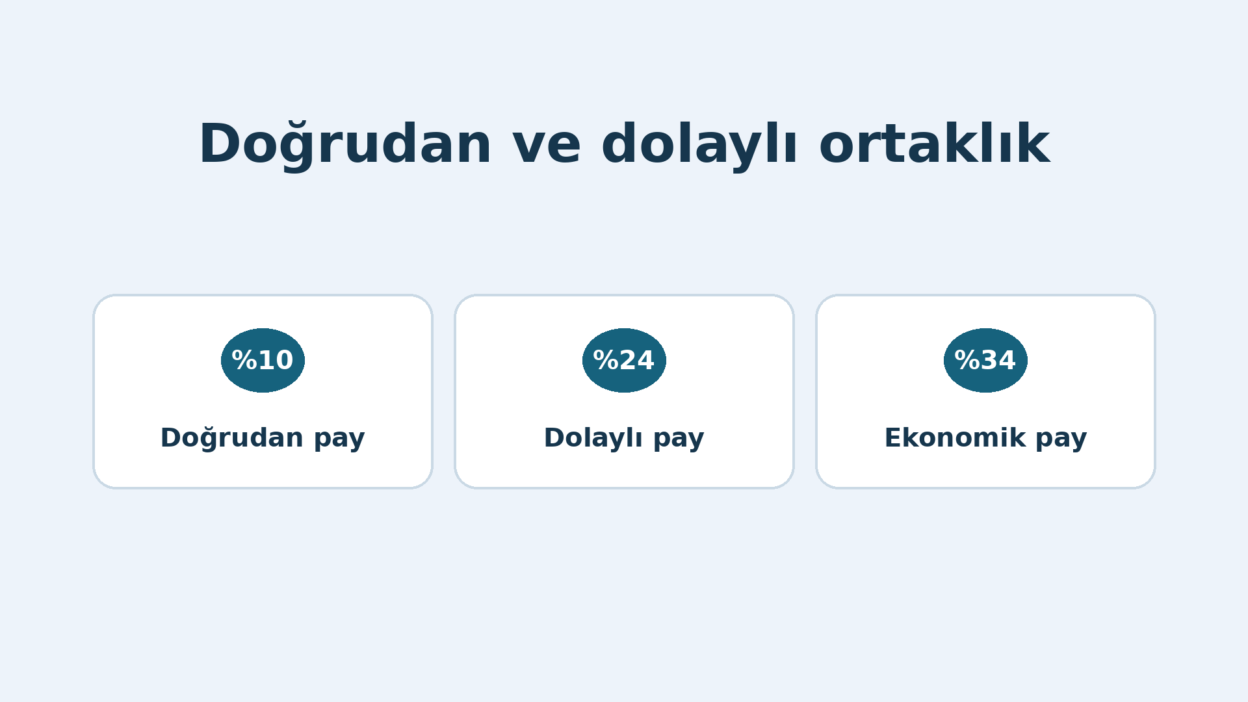
Direct ownership is when a person or company owns a stake in a target company directly, without intermediaries. Indirect ownership is when the stake relationship is established through another company. For example, if a holding owns 60% of an intermediary company, and that intermediary owns 40% of the producer, in a simple proportional economic calculation, the holding’s indirect stake in the producer is 24%. This calculation alone is not enough for management control or voting rights.
At a glance
| Fictional relationship | Stake |
|---|---|
| Kuzey Holding → Ada Yatırım | 60% |
| Ada Yatırım → Deniz Üretim | 40% |
| Kuzey Holding’s indirect economic stake in Deniz Üretim | 24% |
| Kuzey Holding’s direct stake as well | 10% |
| Total economic stake in the simple example | 34% |
How to read direct ownership?
When a shareholder directly owns a stake, they can be seen under their own name in the target company’s shareholder records. For example, Ada Investment directly owns 40% of Deniz Production. The 40% shown in Deniz Production’s table represents the full direct share belonging to Ada Investment. Who Ada Investment’s own shareholders are is found in another company’s table.
Just because a company has ‘holding’ in its name doesn’t automatically mean its stake in the target company is indirect. A holding can be a direct shareholder in another company. Similarly, an individual can own shares through an intermediate company. The distinction comes not from whether the shareholder is an individual or a company, but from the path through the ownership chain to reach the target company.
Why is the indirect stake multiplied?
In the first connection, North Holding’s share in Ada Investment is 60%. In the second connection, Ada Investment’s share in Deniz Production is 40%. In a simple economic share calculation, the first ratio shows how much of the second ratio is being accessed indirectly. 0.60 × 0.40 = 0.24, or 24%. Adding the two ratios gives 100%, but this result does not reflect the economic relationship with the target company. The ratios are calculated according to the capital of different companies.
It’s also possible to think about the same calculation in terms of money. If we give Deniz Production an economic value of 100 units as an example, the part belonging to Ada Investment is 40 units. North Holding corresponds to an indirect economic share of 24 units, based on 60% of these 40 units. This simplified explanation does not mean that the company actually distributes profit or that a payment will be made in this amount. It only helps to see why the ratios in the chain are multiplied.
Is the direct share added to the indirect share?
If Kuzey Holding also has a 10% stake in Deniz Üretim without an intermediary, in the hypothetical example it gains income in two separate ways: a direct 10% and an indirect 24%. In this example, where shares are measured on the same basis and the two paths do not double-count the same shares, the total economic share would be 34%. It would be wrong to add Ada Yatırım’s 40% once more in the calculation. The 24% already represents the portion of that connection that belongs to Kuzey Holding.
In a real company table, first read the definition of the column. Some explanations give direct and indirect shares separately, while others show the total within a certain calculation scope. If the components of the total are already summed up in the report, they should not be added again. If there are multiple intermediate connections between companies, you need to track which share group each path reaches and avoid counting the same share twice.
How are economic stake and voting control separated?
A simple multiplication works well to illustrate the economic share. Voting rights for management control, share classes, and related company documents are also examined separately. In the example, North Holding’s 60% stake in Ada Investment does not mean it has 60% of the votes in Deniz Production. Also, the example doesn’t specify how many votes each share carries in decisions for Deniz Production. So, no definite voting control result can be drawn from the 34% economic example.
When researching a real company through KAP, write each legal entity in the chain with its full title. Then, identify the target company and add each connection’s percentage and registration date on the same line. For example, if the first ratio comes from last year’s report and the second ratio comes from today’s table, first check whether the two records belong to the same period. If one document says ‘share in capital’ and another says ‘voting rights,’ do not use these two numbers in the same calculation. If there is a merger or share transfer announcement, also separate the record of the transaction’s completion. In the final sentence, clearly indicate whether the ratio you used is direct, indirect, or the sum of both.
If the percentages in the example table were announced on different dates, we couldn’t directly use the same calculation. Let’s say A’s share in B comes from an old period report, while B’s share in C comes from a new table after a capital increase. Multiplying these two percentages is mathematically possible, but the resulting number might not reflect the actual ownership structure on a specific date. First, check whether each connection is valid as of the same day. Keep in mind that the share percentages are rounded. A calculation made with an approximate ratio from a table doesn’t become more accurate just because you write more decimal places.